Decision intelligence for SaaS teams

AI is the easy part.
Knowing what your numbers mean isn't.

Every morning, a brief with the decisions worth making today: which accounts to save, which spend to cut, which renewals to push. Grounded in definitions your own team agreed on. You approve every one.

See how it works

Seven quick questions. About two minutes.

  • First brief in 30 days
  • A person approves every decision
  • Your definitions, not ours

The problem

You're automating.
You're just not sure what.

Your team already uses AI. It writes the summaries, answers the questions, drafts the reports. And it does it with total confidence, using whatever it guesses "active user" or "churn" means.

That's the part nobody checked. Product counts an active user one way, sales another, finance a third. Stripe, the finance sheet and the board deck show three different MRR figures. An agent built on top of that doesn't fix the disagreement. It automates it, faster, and hands you an answer that sounds certain.

So the meeting still ends the same way: nobody's sure which number is right, and the decision waits another week.

  • Our AI answers every question. We just can't tell which answers are right.
  • Three dashboards, three MRR numbers.
  • Every real question still ends with an engineer running SQL against production.

What you get

One brief. Every morning.
Decisions, not dashboards.

A short list of what's worth acting on today, with the numbers behind each recommendation, the reasoning, and the exact definition it used. You say yes or no. Nothing happens on its own.

Tuesday · 3 decisions

  1. Churn

    Contact these 4 accounts today.

    Usage down 40% over 14 days: meets your definition of at-risk.

  2. Spend

    Pause Campaign B.

    Acquisition cost 2.1× your agreed ceiling, third day running.

  3. Revenue

    Acme hits its plan limit in 9 days. Propose the upgrade now.

    The last 3 accounts in this position upgraded within a month.

Illustrative example. Your brief uses your data, your definitions and the decisions you choose to track.

How it works

Three steps, and the first one isn't technical.

  1. 01

    Capture

    We interview the people who use your numbers and write down what they actually mean here: MRR, churn, activation, a healthy account. Where teams disagree, we surface it and you settle it. The result is a semantic layer: your company's definitions, written by your people, in a form a machine can use.

  2. 02

    Connect

    We wire your data to those definitions: product database, Stripe, CRM, the spreadsheets. Every figure traces back to its source. It runs on a copy, never against production, sized to the data you actually have.

  3. 03

    Decide

    An agent reads the layer every morning and brings you the decisions worth making, each with its numbers, its reasoning and the definition it used. A person approves or rejects. Rejections teach it what you care about.

Our agents only reason with definitions your people approved.

If it isn't defined, the agent can't use it.

Why us

Most AI projects start with the model. Ours start with a conversation.

Anyone can connect an LLM to your database. What it can't do is know that your sales team counts a trial as a customer and your finance team doesn't. That knowledge lives in people's heads, and it's the difference between an answer and the right answer.

We get it out of their heads first. Then we build.

  • Human definitions, not guessed ones.

    The agent works from what your team agreed, and shows you which definition every recommendation used.

  • A person approves every decision.

    Recommendations, not autopilot, and a full record of what was suggested, approved and why.

  • No data team required.

    You don't need to hire one to get started, and you keep everything we build.

  • Two senior people, no layers.

    The people on the first call are the people who build it.

What we won't do: decide what your company should care about. That's yours. We make sure the machine understands it.

Proof

The foundation, already working.

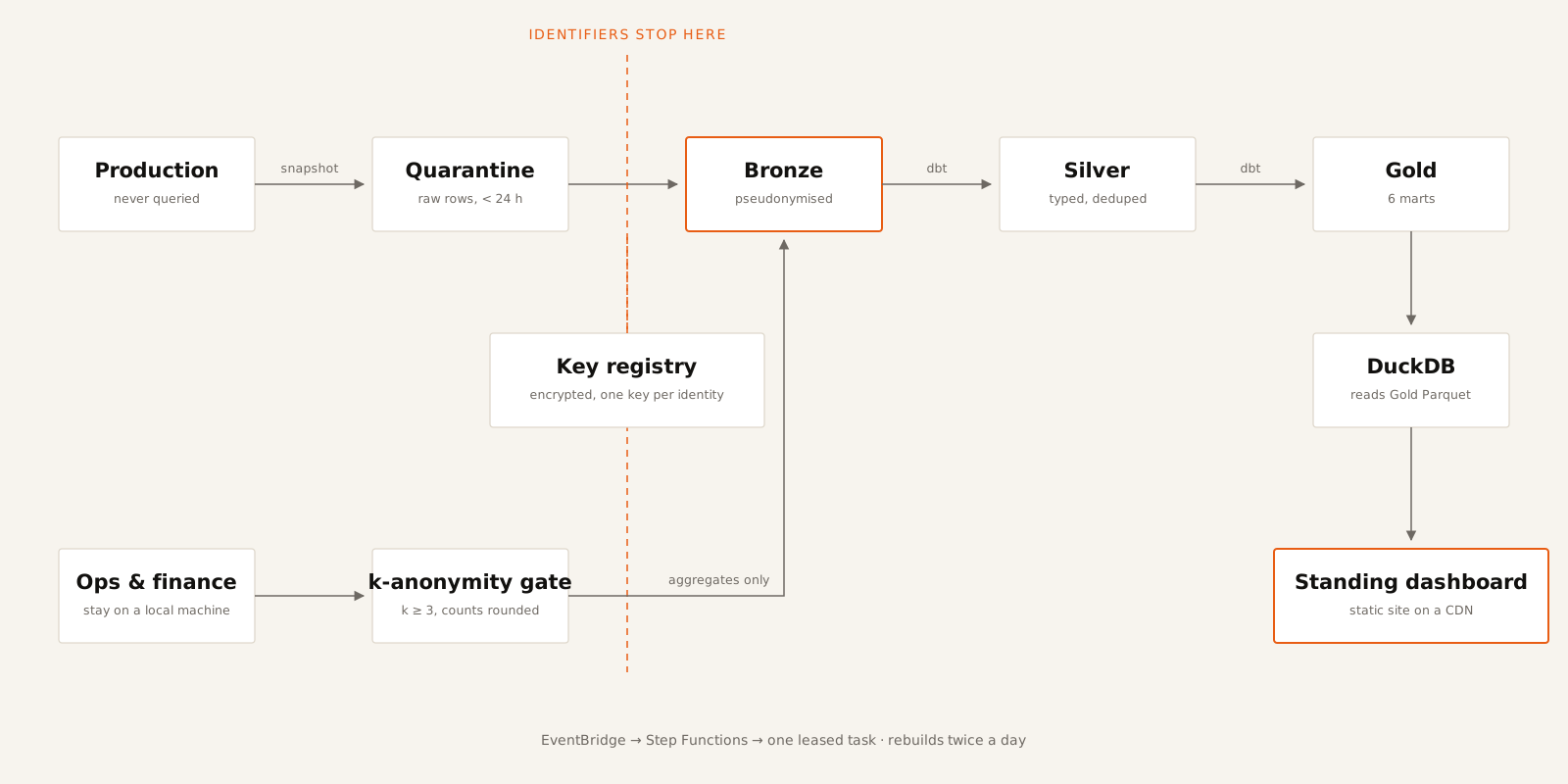
A product company had its numbers in four places: product events in the production database, growth and finance in spreadsheets, and around twenty hand-maintained SQL files run over a connection that dropped mid-query. Every business question meant someone going to fetch the answer, by hand, from production.

We replaced it with one source of truth that rebuilds itself twice a day, with a single agreed definition behind every number and a standing dashboard in place of the queries.

Architecture diagram: production is exported by snapshot to quarantine, identifiers stop at a boundary before Bronze, and Gold is published via DuckDB to a static dashboard.
The whole platform runs on object storage and an embedded query engine. No Spark, no streaming, no warehouse licence.
  • daily rebuild, unattended
  • 0 analytical queries against production
  • 6.5 GB per run, no cluster needed
  • $12 monthly cloud cost for the whole platform

The client's real figures aren't ours to publish; the architecture and numbers above are real, the dashboard figures shown are illustrative.

That's the ground a daily brief stands on. The pilot adds the part that reads it for you.

Who we are

Two of us, and you talk to both.

Mayela

Mayela

Meaning & data

Mayela turns what your team means into something a machine can use. A PhD in linguistics before she became a data engineer, she runs the Capture and Connect steps: the interviews, the definitions, and the pipelines that hold them.

  • Definitions
  • Interviews
  • Python
  • dbt
  • DuckDB
  • AWS
Anthony

Anthony

Agents & decisions

Anthony builds the agent that reads your definitions every morning and brings you decisions, with the approvals, permissions and audit trail that make it a system rather than a demo. He runs the Decide step.

  • Agents
  • Audit trail
  • LLM / RAG
  • API
  • Cloud
  • CI/CD
Excellent communicator and a top-notch professional.
Bryan Orr

Questions

What people ask first.

Do we need a data team?

No. That's who this is for. We connect to what you already have and hand over everything we build.

Will the agent act on its own?

No. It recommends; a person approves or rejects. Every recommendation shows the numbers, the reasoning and the definition behind it.

What data do you need access to?

Read access to the sources behind the decision area you pick: typically the product database (via a copy, never production), Stripe, and your CRM.

We already use a BI tool, dbt, or an AI assistant.

Good. We build on what's there. The semantic layer is the missing piece that makes those tools agree with each other.

What happens after the pilot?

You keep the definitions, the connected data and the brief. If it earns its place, we roll it out to more areas. If not, you've paid for one area, not a platform.

How much does it cost?

It depends on where you're starting from. Answer seven questions and we'll show you the path we'd recommend and what it starts at.

Let's talk

Tell us which decision keeps waiting.

Answer seven questions. It takes about two minutes. We'll show you where we'd start for a company like yours, and what it costs. Your answers go straight to the two of us.

Seven quick questions. About two minutes.